
What’s the Difference between CE and UL 508A for Industrial Control Panels?
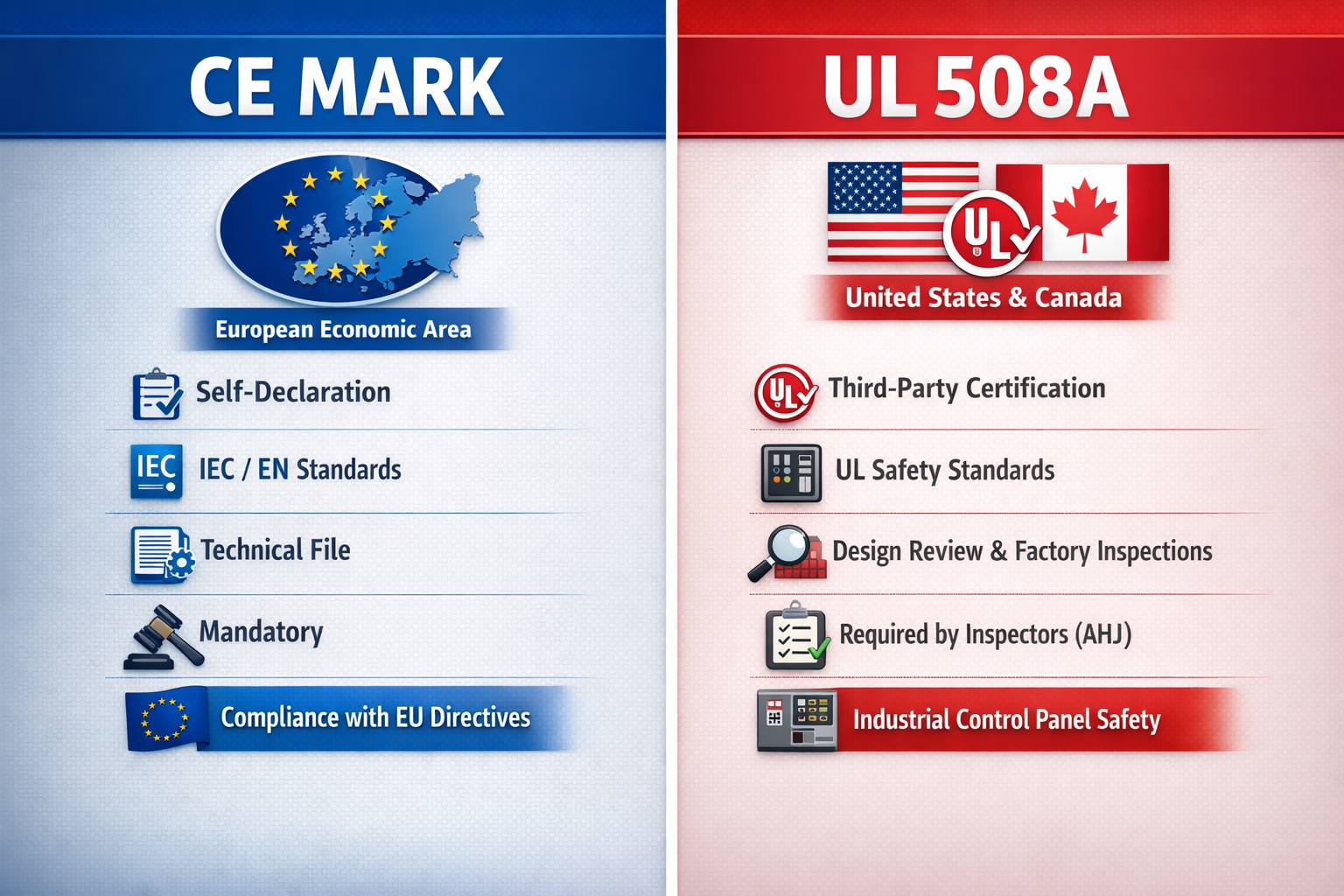
CE certification (mandatory for the EU) and UL 508A (the safety standard for industrial control panels in North America) differ primarily in jurisdiction, certification process, and compliance requirements.
- CE is a manufacturer’s self-declaration that a product complies with applicable EU Directives.
- UL 508A requires third-party certification (UL or another NRTL) to verify compliance with North American safety standards.
Key Differences At-A-Glance
| Category | CE Mark (Europe) | UL 508A (North America) |
| Market Requirement | Mandatory for sale in the EEA | Often required to satisfy NEC and local inspectors (AHJ) |
| Legal Status | Legal requirement under EU law | Required by code enforcement and liability expectations |
| Certification Process | Manufacturer self-declaration with Technical File | Third-party review, testing, and ongoing inspections |
| Standards Basis | IEC / EN standards (e.g., EN 60204-1) | UL standards specific to industrial control panels |
| Component Requirements | Components must comply with relevant EU directives | Components must be UL Listed or UL Recognized |
| Equivalency | Not automatically equivalent to UL 508A | Not automatically equivalent to CE |
Important Note on Harmonization
While the safety objectives are similar, compliance with one does not guarantee compliance with the other.
- A CE-marked panel may not meet UL 508A requirements.
- A UL 508A panel may not satisfy EU Directives.
Global exporters often design to meet both frameworks, which requires attention to:
- Wire color conventions
- Component approvals
- Overcurrent protection methods
- Documentation requirements
Harmonized standards such as IEC 60204-1 can help align mechanical and electrical safety considerations.
Which One Do You Need?
- Europe: CE Mark is non-negotiable.
- United States: UL 508A is essential for safety approval and inspector acceptance (AHJ).
- Global Markets: Dual compliance is common and requires careful engineering alignment.
The Air Dynamics Advantage
One Panel. 100% Compliance. Zero Surprises.
Air Dynamics designs and builds industrial control panels engineered for North American compliance from the start. Designing in line with UL 508A requirements is not just about meeting standards — it is about reducing risk, accelerating approvals, and ensuring seamless deployment.
Built for Inspector Acceptance
Our UL 508A-certified processes support third-party review, factory inspections, and AHJ approval.
Documentation That Protects You
We develop complete Technical Files for CE and maintain rigorous compliance documentation for North American code requirements.
Approved Components by Design
We specify UL Listed / Recognized components and compliant devices to streamline certification pathways.
Faster Time to Market
By designing with UL standards from the outset, we reduce delays during installation, commissioning, and inspection.
The Result
✔ Reduced compliance risk
✔ Fewer inspection delays
✔ Lower total project cost
✔ Increased confidence for your customers
Design Philosophy: Treat the Pollutant, Not Just the Symptom
Air Dynamics applies a minimum of 14 core design review criteria when engineering air pollution control systems, including:
- Pollutant chemistry (reactive vs. inert)
- Combustibility and explosivity
- Capture velocity requirements
- Equipment, placement and integration of the APCD
- Regulatory compliance and secondary waste handling
Particles are treated via filtration; gases and vapors—such as ozone—require chemical or media-based treatment that neutralizes or scrubs the contaminant without transferring liability elsewhere (e.g., to wastewater or other waste stream discharge).
Safety factors were incorporated after baseline calculations, Method of Change (MOC) including a 3D facility model was developed to validate system placement and performance prior to fabrication.
The Engineered Solution
1. Active Wall Air Pollution Control Devices (Qty 2)
- Modular 4-module units with 10 HP exhausters
- High-velocity slot capture to intercept ozone close to the source
- Pulse-jet cleaning system provides reliable sustained airflow to the polluting process
- Multi-stage media filtration with proprietary ozone abatement scrubber
- Reduces ozone from up to 0.6 ppm to <0.03 ppm
- One-year media changeout intervals at 0.6 ppm inlet concentrations
- Compact footprint to avoid incursion into the workspace
- No explosion venting required
- No Class II, Div-2 electrical upgrades required
- No makeup air system required, preserving energy efficiency during winter/summer operations
2. Ozone Treatment Discharge Systems (Qty 2)
- Louvered discharge design for ultra-low velocity reintroduction of treated air
- Configured to adapt to facility airflow and layout requirements
3. Simple HOA Controls and Instrumentation
- Simple HOA (Hand/Off/Auto) based controls with analog filter differential and multiple, continuous digital ozone monitoring
- Variable airflow control to protect welding shielding gas integrity
- Real-time data for compliance verification and operational insight
Turnkey Execution and Support
- Post-award site visit and commissioning
- Installation guidance for mechanical and electrical installers
- Method of change (MOC) safety review with all client stakeholders
- Operator training and maintenance instruction
- UL 508A mechanical and electrical schematics
- 1-year warranty from startup (or 18 months from ship date)
Results and Performance Outcomes
The engineered solution delivered measurable improvements:
- Ozone reduced to <30 ppb (0.03 ppm)—well below regulatory thresholds
- Continuous compliance during 24/7 robotic welding operations
- Reduced operating costs through long media life and low maintenance
- Elimination of makeup air and hazardous-area electrical retrofits
- Seamless integration with existing welding infrastructure
Conclusion
This project demonstrates how disciplined engineering, quantitative analysis, and pollutant-specific treatment can transform a complex environmental health challenge into a stable, compliant, and energy-efficient system. By addressing ozone generation (or any pollutant) at its source and treating it appropriately, Air Dynamics enabled safer working conditions while supporting high-throughput defense manufacturing.
As robotic welding and cobotic systems continue to proliferate across defense, heavy metal processors, and all manufacturing types, engineered systems for air/particles and gases, quality control will remain a critical enabler of productivity, worker safety, and regulatory compliance.
Explore Additional Resources


